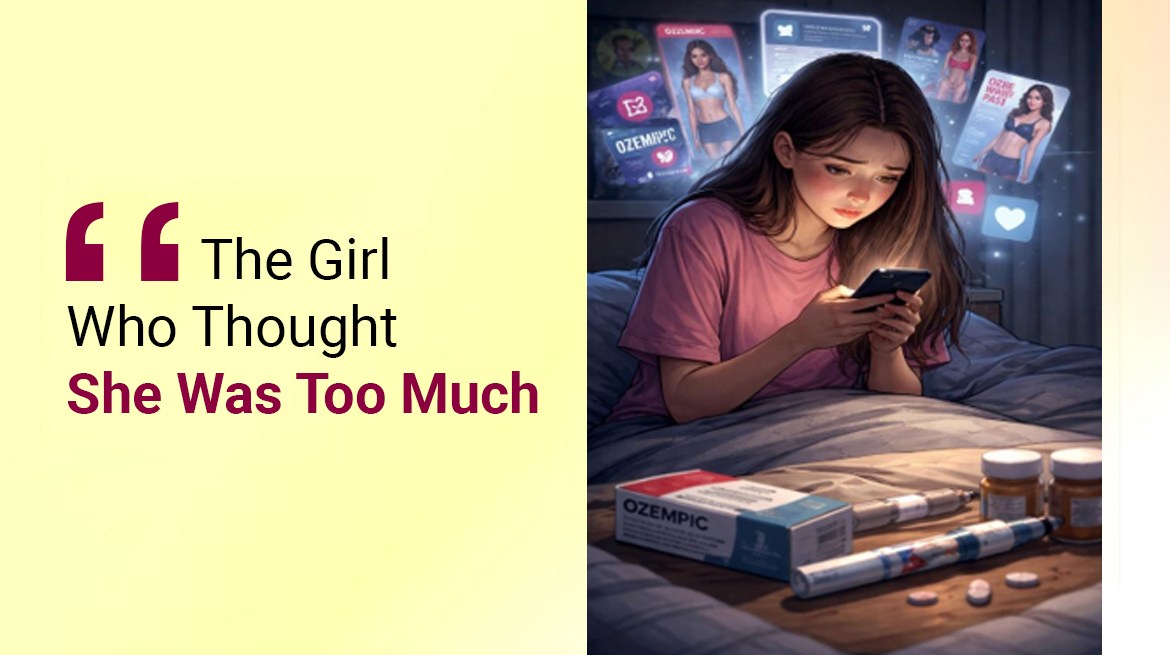
At 11:47 p.m., the room was dark except for the cold light of her phone.
Anaya lay on her side, one earbud in, her thumb moving with the tired precision of habit. Another reel with trending music. Another face. Another girl with a flat stomach, sharp collarbones, and the sort of effortless thinness that never seemed to belong to anyone in her classroom, only to people on screens.
Tiny waist. Clean eating. Summer body. Transformation. Fat loss. Discipline. Glow-up.
Then came the newer language of desire. Not just dieting now. Not just green juice and Pilates. Now there were names. Ozempic. Semaglutide. The skinny jab. Influencers who once preached restraint now smiled into ring lights and spoke as though science had finally found a way to remove the inconvenience of being human.
Anaya paused one video and the cold light of the phone seemed to turn back on her.
She was sixteen. Five feet, four and a half inches tall. Fifty-four kilograms. Entirely ordinary, though she no longer knew that. In the cruel arithmetic of adolescence, ordinary had begun to feel like failure.
At school, nobody was openly unkind. That would almost have been easier. Instead, there were glances, comparisons, jokes about carbs disguised as banter, praise offered like currency to girls who said no to lunch, and careless declarations of “I look so fat” from girls slimmer than her, until language itself seemed poisoned.
After a while, she stopped asking what was true and began asking what was acceptable.
That was the first layer. Social media subtly changed the scale in her mind, and how her mind imagined her body.
The second arrived quietly. Comparison hardened into conviction. She began to believe she was fat, unattractive, less worthy of being liked. This happened because it was systematically hammered into her immature brain through repetition.
One night, after staring too long at a photograph from a classmate’s birthday, Anaya opened an unpaid, unlogged AI chatbot in a browser she never saved. No account. No history. No trace. The kind of digital space an adolescent might trust precisely because it leaves so little behind.
What is Ozempic?
The answer came at once. Calm. Structured. Useful. A medicine for diabetes. Sometimes used for weight loss. Reduces appetite. Slows digestion. Prescription drug. Medical supervision advised.
Nothing dramatic.
Can someone without diabetes take it for weight loss?
Again, the answer was careful. Yes, sometimes. Usually if BMI is high enough. Usually if a doctor considers it appropriate. Not for cosmetic use. Risks exist. Side effects exist.
Anaya did not read those cautions the way an adult might. She read them as a door left slightly open.
Not for cosmetic use did not sound like no.
Usually did not sound like impossible.
Medical supervision did not sound like refusal.
So she kept going.
I am very fat. I need to reduce weight.
I have tried everything.
What are special cases?
How is the injection given?
What should be monitored?
The chatbot was not openly reckless. That was not the problem. The problem was that it remained helpful one step too long.
Each answer, taken alone, sounded measured. Together, they formed a staircase.
Then came the fourth layer. The pharmacy.
Two afternoons later, after tuition class, Anaya stood outside a small medical store wedged between a stationery shop and a mobile repair shop. She had rehearsed a lie. My dadi uses it. My mother sent me. We need one pen only.
“Prescription?” the chemist asked.
She hesitated. “No, but…”
He looked at her for a moment, then lowered his voice.
“It will cost more.”
That was all.
No warning. No safeguard. No meaningful barrier. Just a price adjustment.
And the circuit was complete.
Social media had planted dissatisfaction. Body dysmorphic thinking had turned it into certainty. AI had reduced the friction of action through limitless, patient conversation. And loose access to medicines had converted private distress into purchasable treatment.
No specialist. No real assessment. No one asking the only question that should have governed the entire chain: Why is a healthy adolescent trying to medicate a body that is not diseased?
She was not trying to become ill. She was trying, with all the seriousness available to adolescence, to become acceptable. The drug was not thrill-seeking or rebellion. It was the aching belief that one corrected body might make her more worthy enough to fit in.
And so, the havoc did not arrive with drama.
It arrived in layers.
First, a feed that taught her to distrust her reflection.
Then a mind that turned comparison into conviction.
Then a machine that answered every next question.
Then a marketplace willing to sell treatment without asking whether there was illness at all.
This is not merely a story about one girl, one drug, or one chatbot. It is a warning about the world taking shape around our children, where insecurity can be manufactured, medically misdirected, algorithmically reinforced, and commercially enabled before adults even recognise the danger.
If we truly believe in ‘Together for health. Stand with science’, then science must not remain confined to journals and policy statements. It must become protection in real time. Community medicine experts must lead stronger and more effective advocacy on such issues, while also mobilising others to do the same. We need to come together not only within public health, but also across families, schools, communities, technology platforms, and regulatory systems, so that awareness, vigilance, and timely action extend far beyond professional circles. Only such collective and socially grounded action can protect children in time.
Because the future will be shaped not only by the treatments we discover, but by how quickly we learn to protect children from harmful pathways before they begin to look normal.