
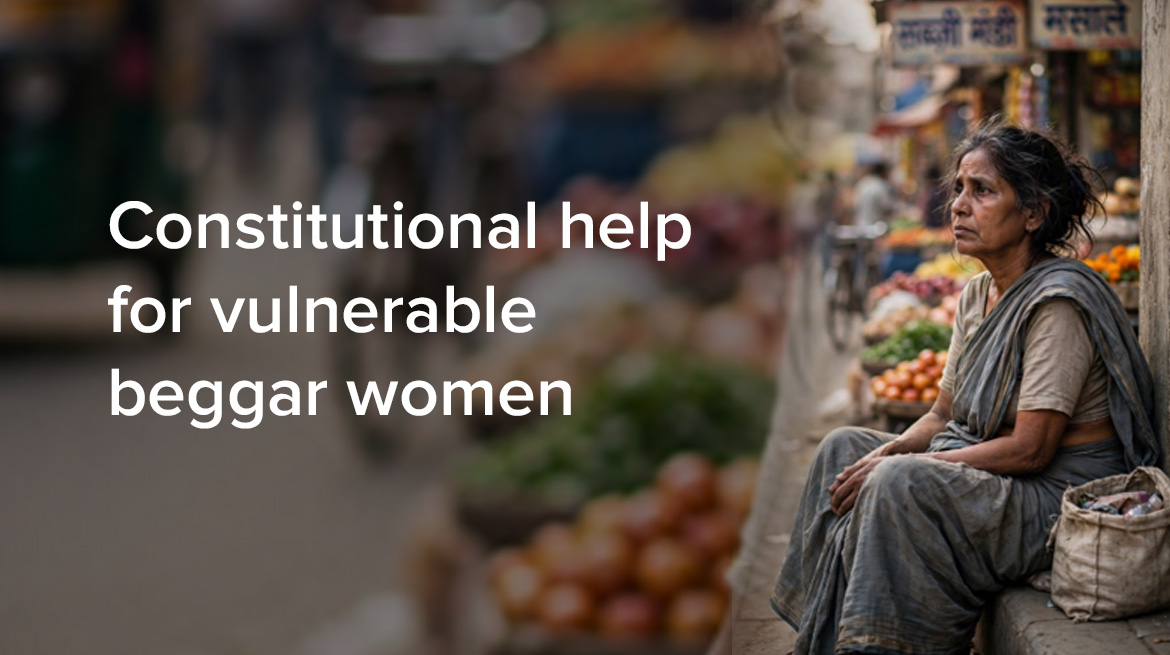
Decent and Dignified Solution for Mentally Ill Women Beggars in India: A Constitutional Perspective
Introduction
Mentally ill women found begging on streets represent intersectional vulnerability – gender, poverty, disability and homelessness. Indian Constitution does not view begging as a crime to be punished, but as a failure of the welfare state. The solution, therefore, is not punitive but protective and rehabilitative, rooted in Article 21.
Constitutional Mandate
A. Fundamental Rights (Part III) – Enforceable by Court
– Article 21 – Right to Life with Dignity: In _Francis Coralie Mullin v. UT of Delhi (1981)_ SC held right to life includes right to live with human dignity. In _Sept 2025 judgment (Re: Conditions in Beggars’ Homes)_ SC declared beggars’ homes are *”constitutional trusts”*, not jails. The Court directed: “Even a person suffering from mental disability is still a human being and his dignity cannot be violated” and chaining is unconstitutional.
– Article 14 – Equality Before Law: State cannot discriminate. Classification of beggars for detention without trial is arbitrary.
– Article 15(3) – Special Provision for Women:
Enables affirmative action for this doubly vulnerable group.
– Article 23 – Prohibition of Traffic and Beggar: Many women are trafficked into forced begging, which is prohibited and punishable.
– Article 24 of Interpretation – Delhi HC in Harsh Mander v. Union of India, 2018: The Delhi High Court struck down provisions of Bombay Prevention of Begging Act, 1959 which criminalized begging, allowed arrest without warrant and detention for 3-10 years. The Court held: “The State simply cannot fail in its duty to provide a decent life to its citizens and then criminalize those very people for being poor” and begging violates dignity under Article 21.
B. Directive Principles (Part IV) – Duty of the State
– Article 39(e) & (f): State to ensure citizens are not forced by economic necessity to enter avocations unsuited to their age/strength and children are protected from exploitation.
– Article 41: Most important provision. State shall make effective provision for securing right to public assistance in cases of sickness, disablement and undeserved want. This creates a positive obligation.
– Article 46: Promotion of educational and economic interests of weaker sections.
Statutory Framework for Dignified Solution*
- a) Rights of Persons with Disabilities Act, 2016
– Mental illness is listed as a specified disability (Sec 2(22) read with Schedule).
– Sec 3-7: Equality, non-discrimination, protection from abuse.
– Sec 25: Right to free healthcare and barrier-free access.
– Sec 29-30: Right to home and community living.
- b) Mental Healthcare Act, 2017
– Sec 18: Right to mental healthcare from State.
– Sec 19: Right to community living, not segregation.
– Sec 20: Right to protection from cruel, inhuman, degrading treatment. Sec 95 prohibits chaining and unmodified ECT.
– Sec 21: Right to equality and non-discrimination.
The Constitutionally Compliant Model (From Punitive to Rehabilitative)
SC guidelines require 5-tier model:
Step 1: Rescue, Not Arrest
No arrest by police under beggary laws. Rescue by a composite team: Executive Magistrate + Women Police + Psychiatrist + DLSA Panel Lawyer + NGO. As Bombay Begging Act’s arrest power is unconstitutional.
Step 2: Legal & Medical Safeguard
Within 24 hours, produce before Magistrate. Appoint Nominated Representative under Sec 14 of MHCA, 2017. Medical assessment by Mental Health Review Board.
Step 3: Short-term Protective Shelter (Not Beggars’ Home)
– SMILE Scheme (Support for Marginalized Individuals for Livelihood and Enterprise), 2022 – Ministry of Social Justice: Central sector scheme for comprehensive rehabilitation of beggars. Two sub-schemes: SMILE for transgender and SMILE for beggars.
– Shakti Sadan (erstwhile Swadhar Greh): For destitute women.
– Shelter for Urban Homeless (SUH) under DAY-NULM: Night shelters with separate wing for women.
– One Stop Centre (Sakhi) & Women Helpline 181.
Step 4: Long-term Rehabilitation
Treatment under District Mental Health Programme (DMHP), issue of Disability Certificate, UDID card, enrollment under NSAP (Indira Gandhi National Disability Pension), Ayushman Bharat PM-JAY, ration under NFSA, PMAY for housing.
Step 5: Special Safeguards for Women
Female caretakers only, frequent rounds of female constables etc, privacy-respecting shelters, periodic medical examination for sexual abuse, some vocational training etc, prohibition of sterilization as treatment for mental illness under MHCA, 2017.
Conclusion
The decent and dignified solution mandated by the Constitution is clear: De-criminalize poverty, Medicalize mental disability, and Institutionalize care as a Right under Article 21 read with Article 41, not as charity.
The State must convert “beggars’ homes” into “rehabilitation homes” functioning as constitutional trusts.
Academic Proposition:
Article 21’s right to dignity is incomplete without Article 41’s right to public assistance. For mentally ill women beggars, Article 21 + 41 + RPwD Act, 2016 + MHCA, 2017 together create an enforceable right to rescue, treatment and community living.
Bibliography / Cases for Citation
- Francis Coralie Mullin v. Administrator, Union Territory of Delhi, AIR 1981 SC 746.
- Harsh Mander v. Union of India, W.P.(C) 10498/2009, Delhi HC, 8 Aug 2018.
- Supreme Court Order on Beggars’ Homes Conditions, 2025 – on dignity of mentally disabled persons.
- Mental Healthcare Act, 2017.
- Rights of Persons with Disabilities Act, 2016.
- SMILE Scheme Guidelines, Ministry of Social Justice & Empowerment, 2022.