
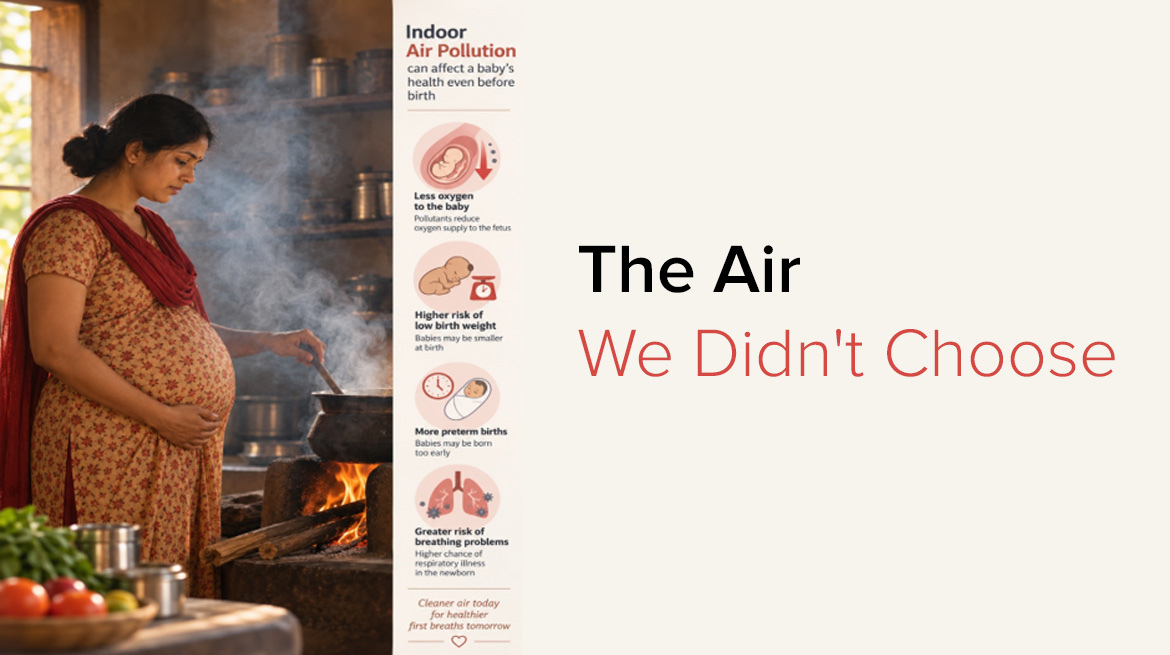
How the smoke inside our homes shapes the first breaths of life
A woman stirs a pot over a wood-fed chulha, nine months pregnant, smoke curling around her face as it has every evening of her life. Inside her womb, a baby is growing — breathing through her, absorbing everything she breathes. Neither of them chose this air. Yet it will shape one of the most vulnerable moments in human life: the moment of birth.
The Invisible Threat in Our Kitchens
Household air pollution comes from burning wood, dung, coal, and kerosene in open fires or inefficient stoves — a daily reality for nearly a third of the world’s population.1 In India, where a large share of households still cook with solid fuels, this smoke fills kitchens with fine particulate matter (PM2.5) and carbon monoxide, pollutants small enough to pass deep into the bloodstream.
Globally, household air pollution caused an estimated 2.9 million deaths in 2021, including over 309,000 deaths in children under five. Nearly half of all pneumonia deaths in that age group are linked to breathing in this smoke.1
From a Mother’s Lungs to a Baby’s Future
For a pregnant woman, this exposure doesn’t stop at her own lungs. Inhaled pollutants can impair oxygen delivery to the foetus, trigger inflammation, and disrupt placental function — the very system meant to nourish and protect the baby.4 The result is restricted foetal growth, a higher chance of preterm birth, and a newborn who begins life already at a disadvantage.
Indian data bears this out. Analysis of the National Family Health Survey-5 (NFHS-5, 2019–21) found children in solid-fuel-using households had substantially higher odds of neonatal death (65% higher) and infant death (55% higher) compared with those using clean fuels.4 Another nationwide study, also based on NFHS-5 data, estimated that 13% of Indian children were born preterm and 17% with low birth weight, with indoor air pollution significantly associated with the low-birth-weight risk.5
A case-control study at a tertiary hospital in Hubballi, Karnataka, looked at this question close to home — examining how a pregnant woman’s exposure to indoor smoke affected her newborn’s birth weight, in a state where solid-fuel cooking remains common.6
The Numbers Tell the Story
- 309,000+ under-5 deaths globally in 2021 linked to household air pollution1
- 1,69,400 under-5 deaths in India from air pollution in 2021 — the highest of any country2
- 5% of India’s air-pollution-attributable disease burden falls on neonatal disorders alone3
- ~2 in 3 pollution-linked cases of preterm birth and low birth weight worldwide are attributed to indoor cookstove smoke7
Behind each number is a baby who never chose the air filling that kitchen — and a mother who, in most cases, didn’t have another option either.
A Story We Can Still Change
Unlike many risks a newborn face, this one is preventable. Clean cooking fuel programs, better kitchen ventilation, and antenatal counselling that flags indoor air exposure as a risk factor are all concrete, achievable steps. As public health practitioners, educators, and communicators, we have a role in pushing this evidence from journals into policy — and into the kitchens where it matters most.
The baby breathing that smoke never had a choice. We do.
References
- World Health Organization. Household air pollution. Fact sheet, 2024. Accessed on 8th Sept 2026. Available at URL: https://www.who.int/news-room/fact-sheets/detail/household-air-pollution-and-health
- State of Global Air 2024 report. Health Effects Institute, Institute for Health Metrics and Evaluation’s Global Burden of Disease project. Accessed on 8th Sept 2026. Available at URL: https://knowledge.unicef.org/CEED/resource/state-global-air-report-2024
- Pandey A, Brauer M, Cropper M et al. Health and economic impact of air pollution in the states of India: the Global Burden of Disease Study 2019. The Lancet Planetary Health, 2020; 5, e25-e38
- Das U, Das L. Indoor air pollution and its impact on child health outcomes in India. Discov Public Health23, 265 (2026). https://doi.org/10.1186/s12982-026-01618-6
- Jana A, Pramanik M, Maiti A, Chattopadhyay A, Abed Al Ahad M (2025) In-utero exposure to PM2.5 and adverse birth outcomes in India: Geostatistical modelling using remote sensing and demographic health survey data 2019–21. PLOS Global Public Health 5(7): e0003798. https://doi.org/10.1371/journal.pgph.0003798
- Andanigoudar KB, Kurgodiyavar M, Roopakala N, Bant DD. Determinants of low birth weight and effect of indoor air pollution on birth weight: A case-control study in a tertiary care centre of Hubballi, Karnataka. J Family Med Prim Care. 2025 Jun;14(6):2426-2430. Doi: 10.4103/jfmpc.jfmpc_1938_24
- Ghosh R, Causey K, Burkart K, Wozniak S, Cohen A, et al. (2021) Ambient and household PM5pollution and adverse perinatal outcomes: A meta-regression and analysis of attributable global burden for 204 countries and territories. PLOS Medicine 18(9): e1003718. https://doi.org/10.1371/journal.pmed.1003718