March 8th- International Women’s Day!
We celebrate the accomplishments of women in an array of fields by sharing empowering videos and highlighting the lives of real-life heroines. They do, in fact, empower us, inspire a desire for equality, and act as the motivation to climb the ladder. However, I always feel that there is a story that goes untold—a generational curse that women continue to bear.
Woman – The Good girl, The righteous Woman, The Goddess
“You should behave properly. “Do not answer back.”
“You are destined to be in another family, so don’t let them slander us”
I am sure most girls have heard this repeatedly, particularly from their mother. We have all been groomed to be good girls, from playing with kitchen toys, training to do home duties to “help mother’, getting stuff for parents and brothers, and compromising favourite ‘leg piece’ for brother. This bigotry starts at home, with our parents. We begin to suffer bodily and mental anguish and neglect without realizing that we are being mistreated. This is being fed in such a subtle manner that we never notice anything strange. Subconsciously, this shapes our identity.
We eventually become nice women, but the repercussions do not go away. The opportunity to choose a career, partner, and life is once again subject to family elders and the health of family members, because ‘good women are expected to take care of everyone and everything.’ This limiting autonomy saps their confidence and possibilities, and potential will be wasted within the confines of the home. They frequently experience mental distress, low self-esteem, sadness, and insecurities that no one observes.
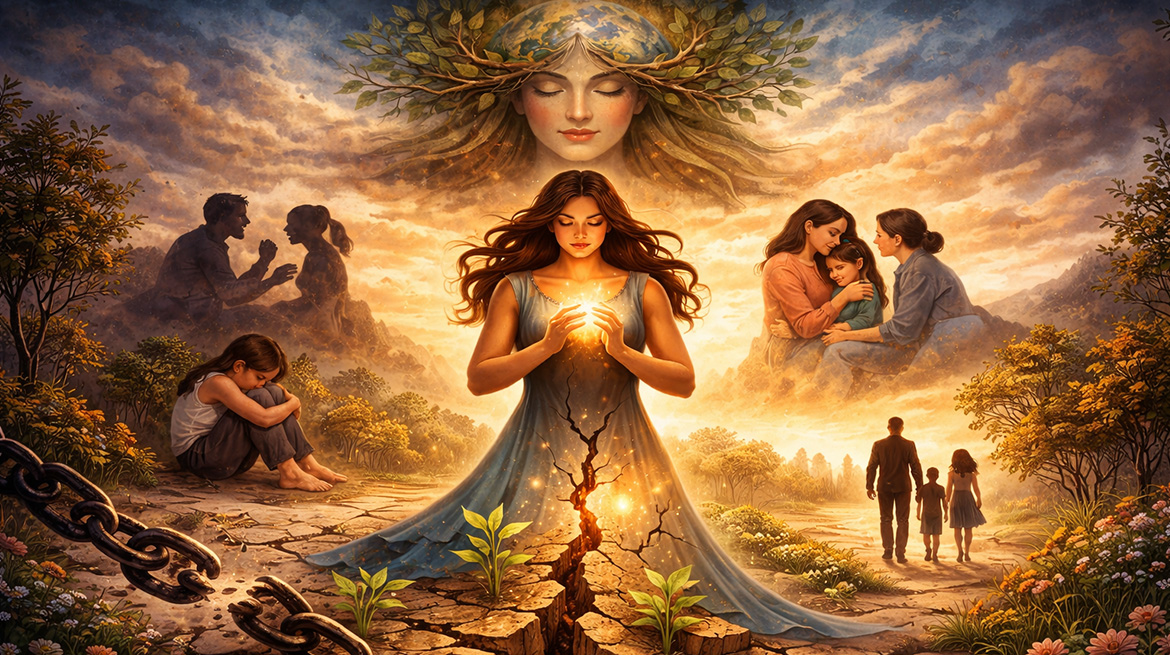
Women are often referred to be Goddess Earth, representing patience and sacrifice. And the ‘goddess’ is frequently pushed to her limits, generating doubts about her competence, character, clothing, and a variety of other factors. We go through it all to keep the goddess alive because sacrifice is more celebrated than her selfhood. The fundamental question is: “Do we really have to?”
Non-inherent intergenerational trauma
The most fundamental aspect of patriarchy is that the pattern of behaviour, response, and family dynamics is unintentionally passed down to the next generation by their own mothers. We rely on the only parenting models we’ve witnessed and experienced as children.
For example, a woman who grew up witnessing domestic violence may see nothing wrong with her significant other engaging in the same behaviour. And she will be unaware of good strategies to resolve disagreements. Similarly, someone who grew up as a neglected kid may struggle to exhibit compassion and support for her child. It is not a lack of love, but rather a lack of such expressions within herself. Patterns unhealed…, unquestioned…!
Breaking the Cycle
This repeats in a vicious circle until someone realises and breaks it, because trauma is not destiny. Some choices becomes revolutionary, when cycles are broken within and self worth takes over silent endurance. Women are clearly catalysts for change in this regard, shaping children’s early environments. A woman who has addressed her own fears might provide a distinct emotional landscape for her children. Such women, and their small transformations, progressively alter the trajectory of families and, on a broader scale, the community.
I’ve always wondered why, given that childrearing is the most crucial responsibility in the world, we seldom speak about parenting and its methods. Parental education is a preventive strategy; healing the bleeding parents ensures a crack-free future generation.
Rethinking Empowerment
Honouring the powerful representation of women in various fields, national and global, I would like to redefine empowerment to include these women who realised ‘this has to end with me’, and refused to pass down what once broke them.
The most powerful message of International Women’s Day is that: ‘Strongest legacy of a woman is not Sacrifice; it is healing!’