A Physician’s Reflection on Tuberculosis and the Weight of Inequality
A Dream Carried Into Medicine
When I chose to become a doctor, I carried a simple dream — to be a source of hope for those who have no one. For the ones who sleep without a roof over their heads, who survive without a meal on their plate, who walk through life invisible to the world.
But medicine humbled me in ways no textbook ever could.
The Disease With a Cruel Name
There exists a disease so deeply intertwined with poverty that it has earned a haunting name —
Tuberculosis: the Poor Man’s Disease.
TB does not discriminate by age or gender, yet it reserves its cruelest hand for those already fighting another battle — survival. In 2022 alone, TB caused an estimated 1.3 million deaths worldwide, with the overwhelming burden falling on low- and middle-income countries.¹
The Privilege of Healing
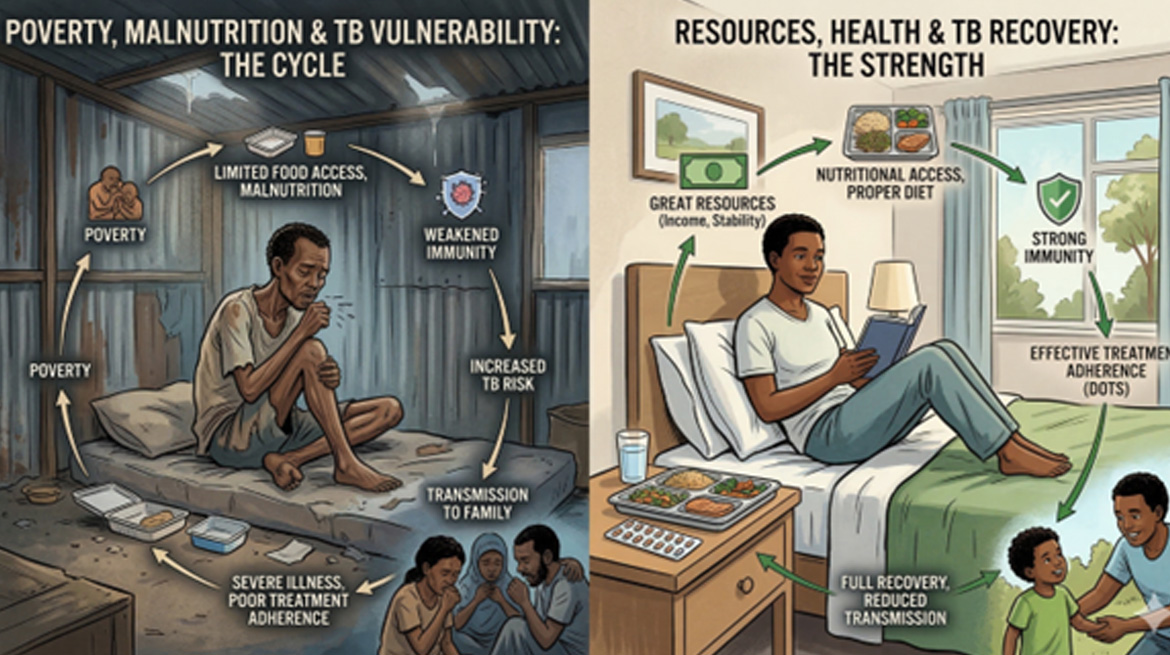
Yes, TB can touch the wealthy too. But privilege is a powerful medicine. Good nutrition, quality supplements, attentive family care, and access to the best treatment form an invisible shield — one that the poor simply cannot afford.
What becomes a manageable chapter in one person’s life becomes a life-defining tragedy in another’s. Malnutrition alone increases the risk of developing active TB by three to four times.² What becomes a treatable infection for the privileged becomes a death sentence for the deprived.
And that is not a medical failure. That is a failure of humanity.
Treating the Root, Not Just the Symptom
In a world that has the resources to ensure every person’s basic dignity, millions still lack the foundation needed to simply heal — clean air, adequate food, and a safe place to rest. We pour our energy into treating the disease, but are we truly treating the person?
The data speaks clearly: reduce poverty, eliminate malnutrition, and strengthen herd immunity — and we begin to strangle TB at its roots. The stethoscope alone cannot do what policy, compassion, and collective will can.
The WHO’s End TB Strategy has set bold targets — a 90% reduction in TB deaths by 2030.³ But strategies only succeed when the social determinants of health are addressed alongside clinical treatment.
With Great Power Comes Great Responsibility
There is a saying we all know — with great power comes great responsibility. Today, I ask those who hold power — policymakers, institutions, communities, and each one of us — to own that responsibility with courage.
Because behind every statistic is a heartbeat. Behind every case file is a mother, a father, a child — a life that deserves more than a diagnosis.
Are you ready to take responsibility?
References
- World Health Organization. Global Tuberculosis Report 2023. Geneva: WHO; 2023. Available from: https://www.who.int/teams/global-tuberculosis-programme/tb-reports
- Bhargava A, et al. Undernutrition and the incidence of tuberculosis in India. Bulletin of the World Health Organization. 2014;92(10):703–711.
- World Health Organization. End TB Strategy. Geneva: WHO; 2015. Available from: https://www.who.int/teams/global-tuberculosis-programme/the-end-tb-strategy.