The act of breastfeeding is one of the most natural, intimate, and powerful phenomena that sustains not just individual human lives but the continuity of the species itself. It is a noble process through which a mother offers a part of herself, her energy, her love, and her very essence to nurture her child. Breastfeeding is not just about transferring calories and antibodies, it is a deeply emotional and spiritual act, an unspoken language of connection and comfort between a mother and her infant.
Scientifically, breastfeeding is defined as the act of feeding an infant with breast milk, either directly from the mother’s breast or through expressed milk. Breast milk is often described as a “complete food” as it is a dynamic, living fluid, rich in essential nutrients, immunoglobulins, enzymes, and hormones. It adapts to the infant’s changing needs, provides ideal nourishment, and builds immunity during the most vulnerable months of life. So simple, yet so profound and significant. It almost feels like a small miracle, nature’s readymade solution for infant survival. But reality, especially in the modern world, is more complicated than we would admit.
Historically, breastfeeding was an innate and unquestioned part of human life. In the times when survival depended on basic elements like food, water, shelter, fire – breastfeeding occurred almost automatically. It was instinctive. There were no other alternatives, no distractions, and no commercial formula industry. But as human society evolved, so did our priorities and distractions. The requirement for basic survival extended into income generation, basic education, occupation, identity in the society, etc. So, the human started chasing everything to live up in the fast growing world. Slowly, subtly, the sacred act of breastfeeding started taking a back seat. And tragically, many mothers were left without the support systems they need to continue breastfeeding.
I have witnessed this reality up close.
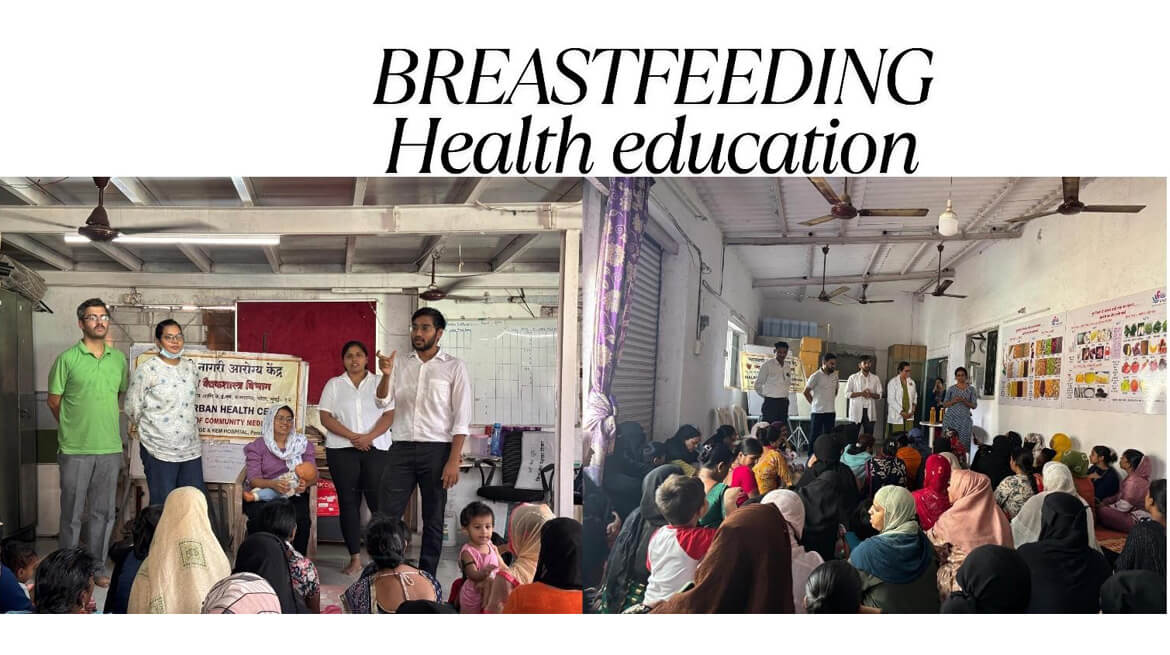
As a medical officer in an urban Primary Health Centre serving a densely populated slum in a metropolitan city, I have seen firsthand how breastfeeding is deprioritized, not by choice, but by circumstances. Most of the residents here live under difficult socioeconomic conditions like overcrowded housing, poor sanitation, erratic electricity, limited access to clean water, individual household toilets and almost non-existent healthcare awareness. These are not just facts, they are lived realities that shape health behaviours, including those related to breastfeeding.
The mothers I meet daily are mostly daily wage laborers or housemaids, often married at very young age, and lacking basic education. Many have little to no understanding of what exclusive breastfeeding means, and its benefits, added to that most of them practice faulty breastfeeding techniques. Their lives are filled with financial burden, social stigma, and layers of cultural beliefs. In their world, myths outpace science. Many here have superstitions that breastfeeding weakens the mother. Religious customs encourage them giving honey or sugar water to newborns. And the demands of work leave no time or energy for continued breastfeeding.
Even when we, as healthcare workers, consistently educate and counsel them about exclusive breastfeeding for the first six months and complimentary feeding atleast till 2 years of age, the uptake remains poor. Because the real barrier is not just ignorance alone, it is the absence of a support system. These mothers are caught in a whirlpool of patriarchal oppression, domestic instability, financial vulnerability, and societal neglect.
You cannot expect a mother to breastfeed when her mental state is exhausted, her body undernourished, and her home unsupportive. Add to that a society that offers no practical assistance like no lactation rooms in public places, no workplace creche or break policies, no maternity protection in the informal sector and so the act of breastfeeding becomes an almost revolutionary task.
So, the issue here is not with the mothers. It is with the system. The very theme of this essay competition “Prioritize Breastfeeding, Create Sustainable Support Systems” aptly addresses the core issue. We need to stop framing breastfeeding as solely the mother’s responsibility. We must expand the lens and understand that breastfeeding success is a shared societal responsibility.
Sustainable support systems mean creating an ecosystem that inform, anchor, engage and galavanize breastfeeding in both visible and invisible ways. At the family level, it means husbands, mothers-in-law, and even siblings recognizing the importance of breastfeeding and helping the mother with rest, nourishment, and time. At the community level, it means local leaders, health workers and NGOs reinforcing correct information and busting myths. At the policy level, it means stronger maternity leave laws, designated breastfeeding spaces in public and work settings, flexible work hours, and welfare schemes for lactating mothers especially those in the informal workforce.
As a community medicine resident, I have come to understand that sustainable support does not mean one grand intervention. It means many small ones, consistently implemented. Like it can be PHC with special breastfeeding counselling services. A peer group of new mothers sharing stories. A local leader who tells men to support their wives. A government office with a breastfeeding room. And a society that finally learns to stop staring when a mother feeds her baby in public.
In conclusion, breastfeeding must be seen not only as a maternal responsibility but as a collective duty of society. When we prioritize breastfeeding, we are not just feeding a child, we are building the foundation of a healthier, more equitable future. And when we create sustainable support systems, we are telling every mother: “You are not alone. We are with you.”