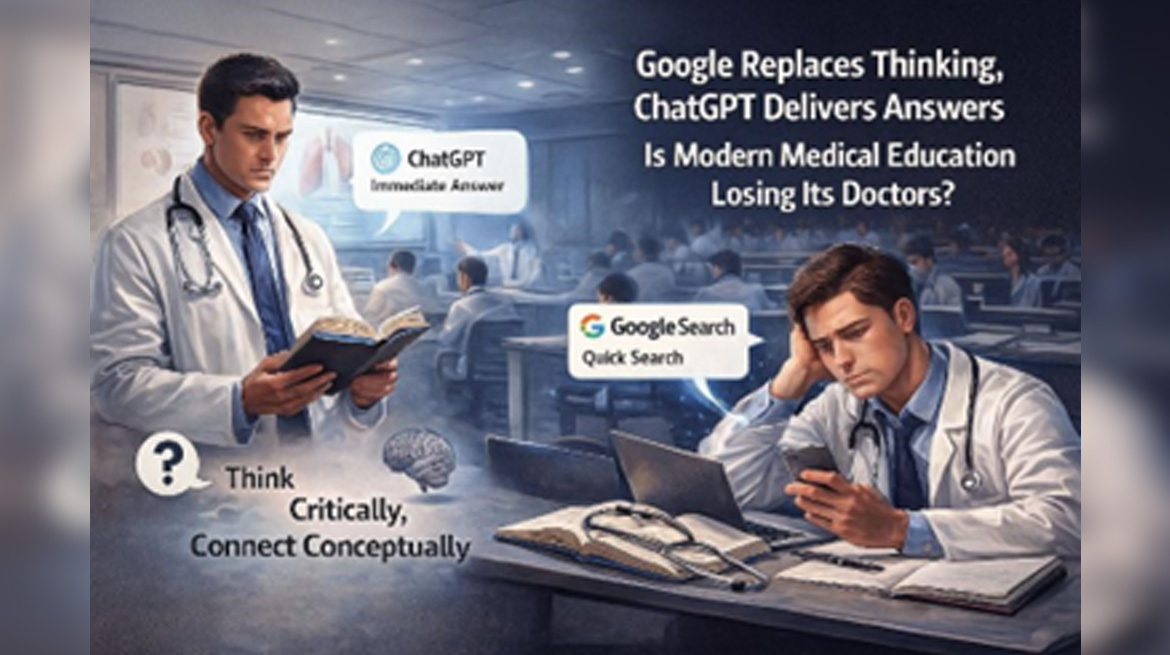
There was a time when medical students sat with heavy textbooks, highlighters, and a thousand doubts swirling in their minds. They learned by questioning, debating, and staying up late to truly understand how a human body works. Today, things look different. Students still have doubts — but instead of thinking, they reach for their phones. Google answers instantly. ChatGPT explains instantly. And slowly, silently, thinking disappears.
This change feels small on the surface, but deep down, it is reshaping the future of medicine.
We cannot blame students entirely. The digital world is built to make life easier. If a summary is one click away, why read ten pages? If an explanation is instantly available, why struggle?
But here’s the truth no one wants to say out loud: What comes too easily is forgotten just as easily. – Real learning, especially in medicine, is supposed to be uncomfortable. It’s supposed to challenge your brain, force you to connect, compare, analyse, and think deeply. When that struggle disappears, understanding disappears too.
Teachers often share the same worry:
“Students don’t participate anymore.”
“Their attention is gone within minutes.”
“They prefer screens over classrooms.”
It’s not because they’re lazy — it’s because their brains have been trained by fast content, quick reels, and instant responses. A 45-minute lecture feels slow in a world where everything moves in seconds. But medicine cannot be learned in seconds. It is built on depth, patience, and repetition — things the digital world does not easily offer.
When students read simplified notes or AI explanations, everything sounds clear. It feels like: “I get it.” But the feeling is misleading.
Understanding feels good. Real understanding stays.
Without grappling with the “why” and “how,” students may think they know a topic but cannot apply it when faced with a real patient.
This is the heart of the crisis: we are raising confident students… but not competent doctors. How technology silently weakens learning, it reduces patience.it lowers attention span., it encourages memorisation instead of reasoning, it makes students dependent on instant answers.
AI can help explain. It can guide. But it cannot think- And thinking is the most important skill a doctor must have.
A Path Forward
We don’t need to reject technology — we need to balance it.
- Students must learn to use AI as a tool, not a substitute.
- Teachers must bring more real cases, real stories, and real problem-solving into classrooms.
- Institutions must emphasise understanding over marks.
When students see how deeply a concept connects to a real patient’s life, something changes. Curiosity returns. Motivation rises. Learning becomes meaningful again.
At the end of the day, medicine is not about passing exams. It is about saving lives. And no shortcut, no Google search, no AI prompt will ever replace the thinking brain of a well-trained doctor.
Because:
Google can replace thinking.
ChatGPT can deliver answers.
But only dedication, struggle, and true understanding
can create a doctor.
REFERENCES
- Kirschner, P.A., & De Bruyckere, P. (2017). Digital native & multitasking myths. Teaching and Teacher Education, 67, 135–142.
- Mayer, R.E. (2009). Multimedia Learning. Cambridge University Press.
- Shaffer, D.W. (2019). AI in education and human judgment. Educational Psychologist, 54(3), 207–221.
- Ferguson, C. (2017). Digital distraction. Journal of Medical Education, 51(2), 82–90.
- Patel, V.L. et al. (2000). Clinical reasoning. The Lancet, 356(9231), 1057–1061.
- Sweller, J. (1988). Cognitive load theory. Cognitive Science, 12(2), 257–285.