
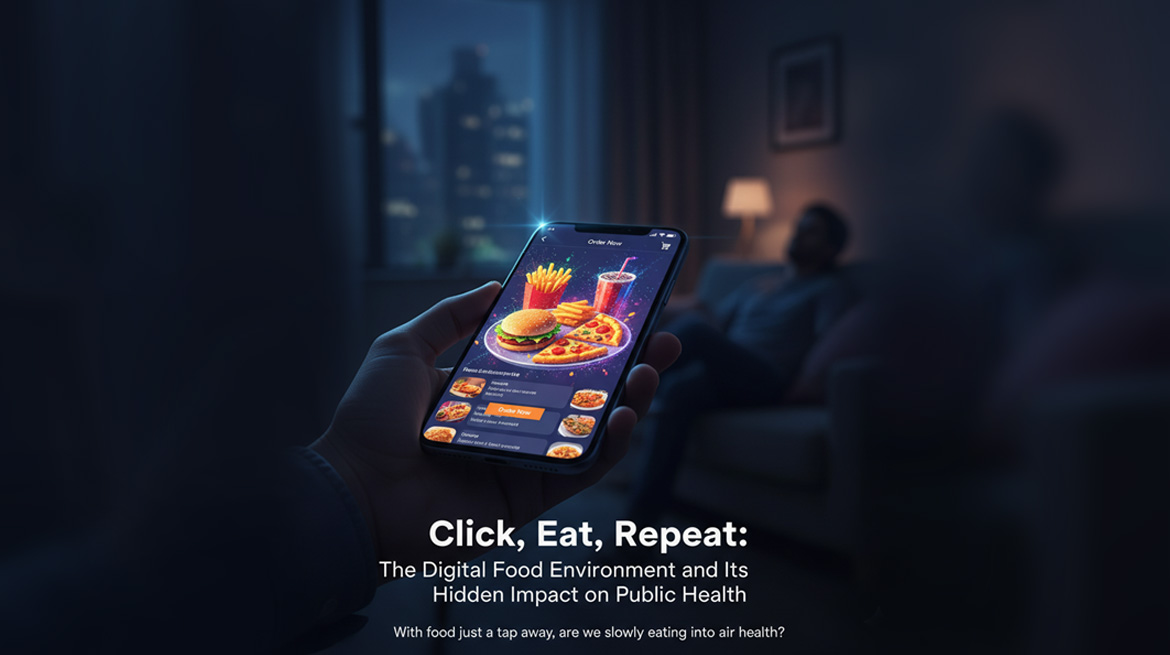
With food just a tap away, are we slowly eating into our health?
Over the past decade, India’s urban foodscape has undergone a dramatic transformation – not by the aroma of street food stalls or the bustle of vegetable markets, but by the quiet convenience of delivery apps. Blinkit, Zomato, Swiggy, Instamart, and similar platforms now allow people to satisfy hunger without ever stepping out of their homes. While they cater to convenience, these digital food environments carry implications that the public health community cannot afford to ignore.
The Rise of the “Swipe-to-Eat” Generation
Today, food isn’t just consumed – it’s delivered. Whether it’s a 10-minute grocery run or a midnight pizza craving, these services have become an integral part of the urban Indian lifestyle. But the question is – what are we trading off for comfort?
Physical Inactivity
The biggest invisible cost of food delivery is the erosion of incidental physical activity.
Walking to the market, standing in queues, and carrying bags home
These are no longer part of daily routines. Instead, they’ve been replaced by screen time and sedentary waiting. The consequence? A silent rise in overweight, obesity, insulin resistance, and non-communicable diseases (NCDs) – especially in young adults and working professionals.1
Ultra-Processed, Ultra-Frequent
Digital menus are not just about food – they’re about algorithms.
- Repeated exposure to high-calorie, ultra-processed meals
- Heavy discounts on fried, sugary, and packaged snacks
- Suggestive marketing based on past orders
The “Cyber Food Swamps” study revealed that a 10% increase in fast-food visibility on delivery platforms corresponded to a 22% higher likelihood of fast-food orders.3
The Urban Health Paradox
While India fights hunger and malnutrition on one hand, cities are facing a different epidemic:
- 24/7 food access without movement
- Emotional eating patterns are shaped by stress, marketing, and ease
- Digital dependence that reshapes sleep, screen use, and social habits
This paradox of “malnourished yet overfed” needs serious attention.
Public Health Evidence: What Are We Seeing?
A recent study at IIT-Guwahati found that food delivery apps and social media are significantly influencing eating habits and food culture among urban Indian youth, particularly in the middle class. The study introduces a sixth stage in the food cycle – digitalisation – and calls for inclusive digital policies to support public health and food diversity 3
Frequent use of food delivery apps is associated with decreased physical activity and increased sedentary behavior, contributing to the growing prevalence of obesity and metabolic health risks, particularly among urban youth 4.
Final Thoughts
The digital food environment isn’t inherently harmful, but our passive relationship with it is. We must reclaim agency over our food, movement, and minds. Just as we adapted to infectious disease shifts, we must now address the silent pandemic of digitally driven chronic diseases.
We must begin to question not just what we eat, but how it reaches us – and at what hidden cost to our bodies and minds.
References:
- Willie, Michael & Qadir, Afshana & Maqbool, Mudasir. (2024). From click to calories: Navigating the impact of food delivery apps on obesity. Open Health. 5. 1-4. 10.1515/ohe-2023-0022.
- Sree Lakshmi A. The impact of digital convenience services on sedentary lifestyle and public health among urban youth. Int J Res Appl Sci Eng Technol. 2023;11(2):456–460.
- Zhang Y, Fan Y, Liu P, Xu F, Li Y. Cyber Food Swamps: Investigating the impacts of online-to-offline food delivery platforms on healthy food choices. In: Proceedings of the International AAAI Conference on Web and Social Media; 2025 Jun 7; Atlanta, GA. Vol. 19. p. 2260–72.
- The rise of food apps and the sedentary lifestyle: a recipe for health concerns? Natural Nutrition Clinic. 2024. Available from: https://naturalnutritionclinic.com/the-rise-of-food-apps-and-the-sedentary-lifestyle-a-recipe-for-health-concerns/
- Social media, food delivery apps transforming food culture in urban India: IIT-Guwahati study. Mid-Day. 28 Jun 2025. Available from: https://www.mid-day.com/lifestyle/food/article/food-delivery-apps-social-media-transforming-food-culture-in-urban-india-iit-guwahati-study-23582062