
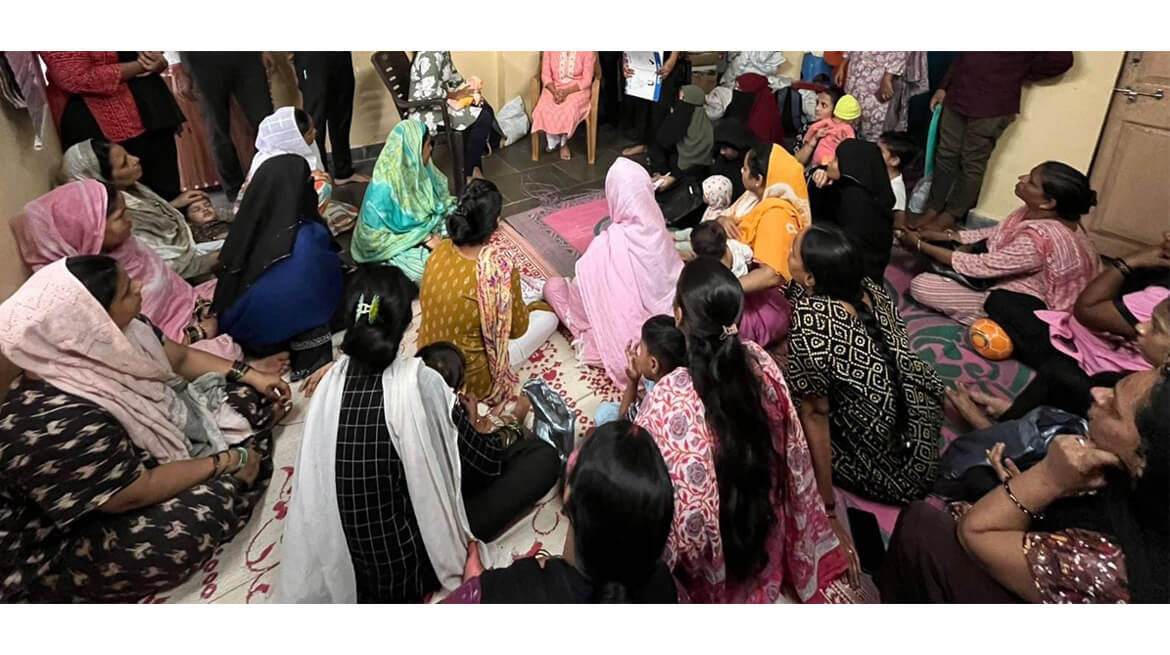
The morning sky was foreboding, the sort that threatened before it poured. By the time I ventured out, Mumbai was already drenched. The air carried the acrid smell of damp clothes and wet soil, and rivulets of rainwater flowed along the slim lanes. That day we had our breastfeeding awareness session for World Breastfeeding Week.
With posters, breast models, dolls, and flip charts, we trudged through the narrow alleys, puddles splashing under our sandals. The roofs of shanty homes dripped rhythmically, plastic sheets flapping. I grasped my bag nervously, not about the rain, but about attendance. Who would step out, babies in tow, on such a day?
At the Anganwadi, I paused at the door. The room was tiny—10 by 12 feet—but warm despite the rain. Its walls bore tattered posters: alphabets, vaccination charts, and children’s drawings curled at the edges. In one corner lay weighing scales, toys, and registers.
To my surprise, a small cluster of mothers was already seated cross-legged on thin mats—some with babies, others patting restless toddlers. They looked weary, hair still damp, saris clinging to their backs. One young mother cradled a newborn wrapped in worn pink cloth; another carried two children—an infant in her lap and a toddler tugging at her sari pleats.
As we settled in, more women straggled in, shaking water from dupattas, wiping brows, murmuring hellos. Relief washed over me. I had feared no one would come, but here they were—choosing to come, choosing to learn. Soon the little room was packed: the rustle of saris, the cry of a baby, and conversation blending with the pounding rain on the tin roof.
We began with appreciative inquiry, asking mothers to share their breastfeeding experiences. At first, silence. They looked around nervously, as though seeking the “correct” response. Then, hesitantly, one mother raised her hand.
She smiled demurely and replied, “Mera baccha chhe mahine ka hai… ab tak ek bhi baar bimar nahi pada.”
(My baby is six months old and hasn’t ever fallen ill once.)
The tone was gentle, but her pride spoke louder in her eyes.
Another mother interrupted, her words tumbling quicker now that she had gained confidence. She mentioned that breastfeeding had been her solace on sleepless nights; holding her baby close to her chest brought a sense of calm when the world outside seemed too much to handle. Another chuckled and added how her husband came to her defense for deciding to breastfeed exclusively when relatives kept suggesting she change to cow’s milk prematurely. This made some women smile and nod, some of them whispering their own similar struggles at home.
It was like a dam bursting—the room gradually came to life. Narratives flowed, laughter filled the air, and encouragement from one mother to another. One young mother confessed softly that she had been tempted to feed her baby cow’s milk after observing her neighbor to do so, but abstained when the Anganwadi worker explained the need for exclusive breastfeeding.
I observed as they started to read out out loud repeated important points together, like a mantra:
“Chhe mahine sirf maa ka doodh.” (Six months, only mother’s milk.)
“Paani nahi dena.” (Don’t give water.)
“Formula doodh behtar nahi hai.” (Formula milk isn’t better.)
It was powerful—the way they learned all together, clutching every word as if it were a vow to themselves and their babies.
There was chaos in the room, babies wept, toddlers pulled at saris, a corner of the roof leaked continuously into a tiny steel bowl, and yet… there was concentration. The mothers were totally present, taking in, giving out, and supporting one another.
When the official session broke, the chatter didn’t. Some women remained behind, keen to pose questions—about their own diet, about coping with breastfeeding once back at work, about sore nipples, and even about coping with stubborn relatives recommending formula. Another asked how she could express and store her milk safely once she returned to her work as a housemaid. Their concern and interest brought the session to life, going beyond anything script or agenda we had brought.
When we emerged outside, the rain reduced to a drizzle. My shoes squelched at each step, and my umbrella dripped unceasingly against my arm, depositing cold little spots on my sleeve. But my thoughts were no longer on the rain.
I kept thinking back on the scenes inside that small room—the dampened clothing, the serious repetition of “six months only mother’s milk,” the prideful tone, and most of all, the resilience in their silent determination.
That day taught me something no textbook ever would: communities don’t just require information—they require reassurance, belonging, and the freedom to celebrate what they are already doing well. Appreciative inquiry wasn’t merely a process; it was a bridge. It gave these mothers the permission to be proud, to learn and teach from each other, and to stand behind their choices with pride.
It wasn’t an auditorium hall, there were no banners or microphones. It was a small room in the rain on a rainy afternoon in the slums. And amidst the packed tiny space, I witnessed resilience, warmth, and hope in its most unadulterated form.
I returned wet, aching feet, but in my heart a secret quiet fullness—a feeling that what we had seen there was more than session. It was connection. It was community. And it’s something I still retain today.