As public health professionals, we are no stranger to arguments when it comes to administering vaccinations, with nothing quite stirring up controversy like the HPV vaccine. Mothers have fears regarding safety, novelty, and taboo issues, while teenagers have apprehensions surrounding pain and myths spread due to ignorance. The result can be an argument, losing chances for vaccination. This is where motivational interviewing (MI) comes into play—a non-confrontational approach backed by scientific proof.
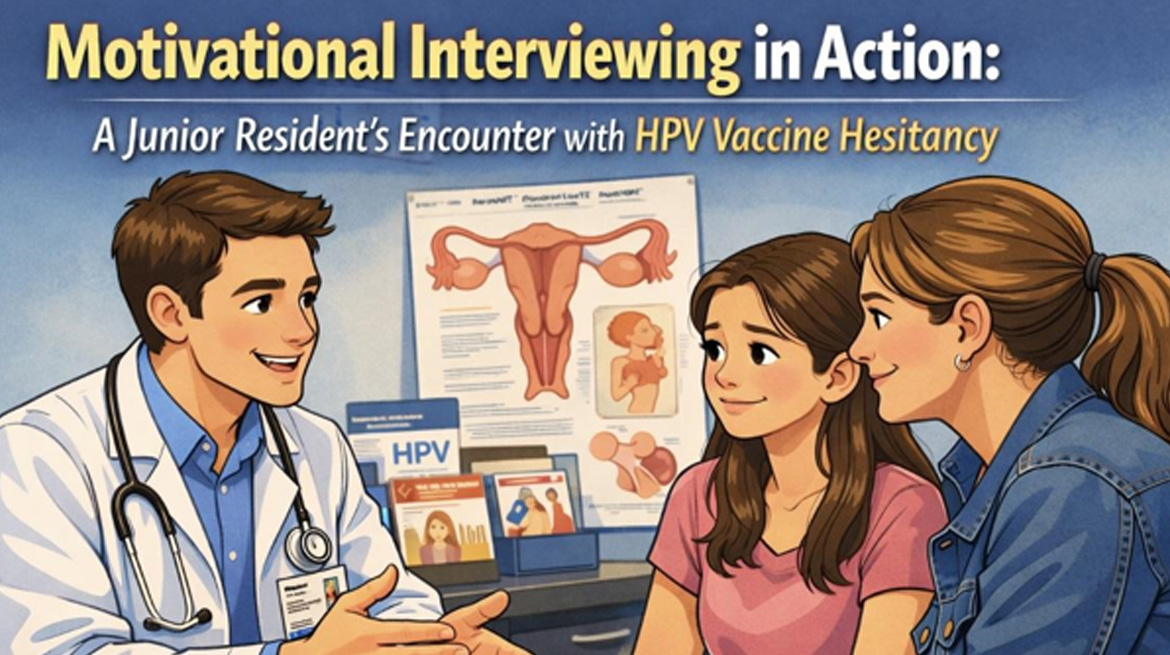
In an active session at the Health and Wellness Centre, I, as a Junior Resident Doctor in the Department of Community and Family Medicine, came across a 13 year old girl, who came to the centre accompanied by her mother. As part of the standard procedure in prevention of health complications, I mentioned the importance of getting the HPV vaccine, a very effective means of protection against cervical cancer.
As soon as I suggested getting vaccinated, I noticed signs of hesitation.
“Doctor, there were cases where this vaccination caused fertility issues…” her mother carefully asked.
Even more worried, the adolescent girl shared similar concerns about future fertility problems after getting the HPV shot.
This situation shows one of the most common misconceptions about vaccination, namely, the idea that HPV vaccines cause problems with fertility. Instead of rejecting this misconception, I applied Motivational Interviewing in practice.
Listening to the fear behind the Myth
I started off by recognizing their worry:
“I’m actually quite happy you mentioned this because there are many other parents and teens who have also heard things like this. Could you share with me what specifically you have heard?”
It turned out that her mother had heard from different people online about how it would “harm the uterus” or “make conception difficult in the future.” The girl also shared that some of her friends believed it could “interfere with hormones.”
The Emotions Behind Infertility Fears
In India, fertility is an essential part of individual identity, marriage, and acceptance within society. Hence, infertility fears go beyond being medical—infertility fears are deeply emotional, intercultural, and transgenerational.
Gently Addressing Myths with Evidence
Instead of directly countering the myth, I asked permission:
“Would it be okay if I shared what we know from research and global experience?”
Once they gave me permission, I elaborated:
- There’s no scientific proof of any connection between the HPV vaccine and infertility.
- It doesn’t impact the uterus, ovaries, and hormones.
- It has been administered safely to millions of girls around the world.
- In fact, it helps you maintain fertility because it prevents cervical cancer.
I simply stated:
“It’s good for your health—including having kids in the future—instead of damaging your fertility.”
Eliciting the Adolescent’s Perspective
Speaking to the girl, I posed the question,
“Now, what do you think after listening to all this?”
After thinking for a moment, she replied,
“I had no idea that the cure of cervical cancer can influence fertility… I believed that only the vaccine would do this.
Addressing Residual Doubts without Confrontation
Her mother was still in doubt.
“Doctor, if so many people are saying that, how do we really know which one is right?”
Rather than brushing off her worries, I considered:
“Sometimes it is difficult to keep up with all the information available.”
Then, I went on:
“In my opinion, you could consider it like this—the global health organizations, including the national immunization programs, endorse the use of this vaccine following their rigorous safety evaluations. They would not do so if it had any effects on fertility.”
Reflections for Public Health Practice
This event emphasizes a crucial fact:
Infertility myths are some of the strongest catalysts for HPV vaccine hesitancy.
Main misconceptions are:
- The HPV vaccine causes infertility
- It harms reproductive organs
- It affects hormones or puberty
Such beliefs have been able to thrive due to the fear-based nature of their content. Dispelling such misconceptions demands empathy and not merely facts.
Why Motivational Interviewing is Important ?
Motivational Interviewing was instrumental in changing this conversation because:
- It provided a secure environment for sharing worries.
- It validated emotions without promoting myths.
- It replaced aggression with cooperation.
- It gave both the mother and teenager the chance to make an informed choice.
Conclusion
When dealing with patients who have high conflict levels regarding vaccination, particularly with concerns about infertility, the role of the healthcare professional isn’t to win an argument.
It is important to know that the HPV vaccine doesn’t only prevent cancers but also protects future fertility of adolescents. However, without debunking myths sensitively, this information will probably never reach the patient.
As I came to understand that day, the best way to deal with false statements is often not through correction, but through active listening, empathic understanding, and wise guidance.