
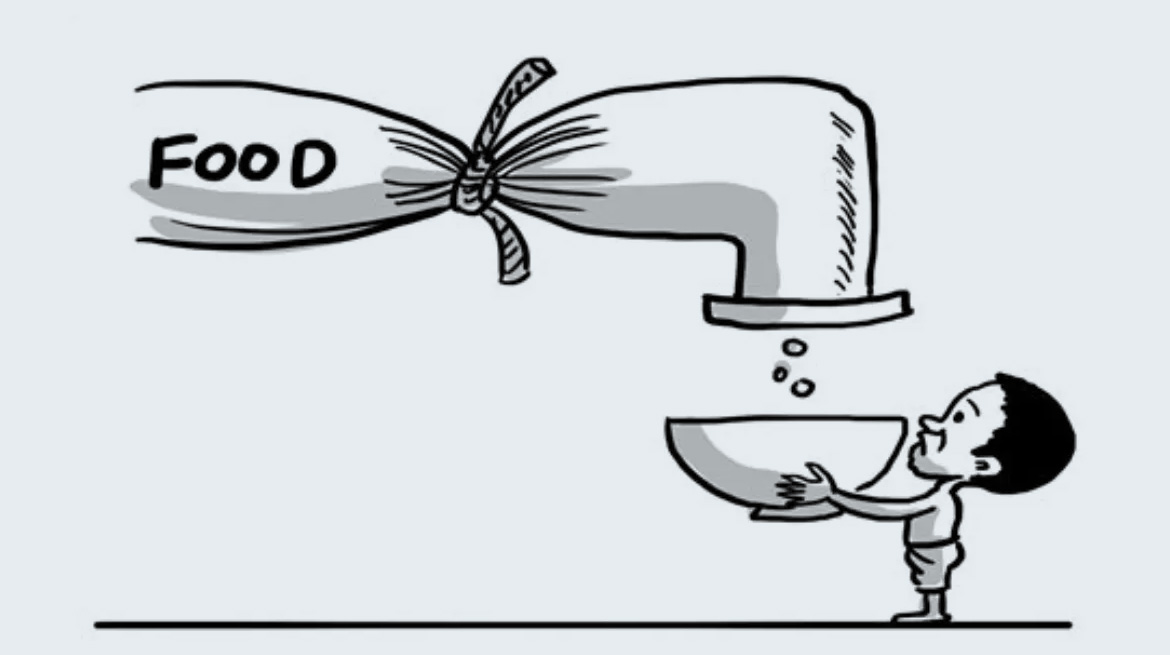
The most recent data shows that India continues to have a serious malnutrition problem, ranking 111th out of 125 countries on the Global Hunger Index (GHI) with a “serious” level of hunger. These issues are primarily caused by poverty and systemic inequalities that affect access to wholesome food.
Compared to nations with comparable rates of economic growth, the progress has been sluggish, despite a minor improvement from its 2015 score of 29.2. At 18.7%, India also has the highest rate of child wasting worldwide. Additionally, 35.5% of children under five have a medical diagnosis of growth stunting, which can result in long-term developmental issues.
Over 389 million people in South Asia are living below the $3.65 per day poverty level, with India contributing nearly 40% of the world’s poverty rate, according to the World Bank. According to data from the Population Reference Bureau, 62 million children, or 48% of India’s kid population, suffer from malnutrition as a result of this economic hardship, which also raises their risk of disease and impairs their cognitive development.
Re-evaluation from a new lens advocated that since the Global Hunger Index (GHI) is a flawed measure of “Hunger,” it does not accurately depict India. Since it is neither suitable nor indicative of the level of hunger that exists in a nation, it should not be taken at face value. Only one of its four indicators—undernourishment—has a direct correlation with hunger. In addition to hunger, the two indicators—stunting and wasting—are the result of intricate interactions between a number of other factors, including sanitation, genetics, environment, and food intake utilization.
The Indian government has prioritized the issue of malnutrition & is actively seeking solutions.
The initiatives known as POSHAN Abhiyaan and the Anganwadi Services Supplementary
Nutrition Programme have been revitalized and amalgamated into “Saksham Anganwadi and POSHAN 2.0” (Mission Poshan 2.0). This initiative aims to tackle malnutrition among children, adolescent girls, expectant mothers, and new mothers by implementing strategic changes in nutritional content and its delivery, along with creating a cooperative ecosystem that fosters healthy habits, well-being, and immunity.
The focal areas of Poshan 2.0 include Maternal Nutrition, guidelines for Infant and Young Child Feeding, treatment for MAM/SAM, and wellness through AYUSH.
Poshan Abhiyaan, the primary outreach component, involves innovations in community participation, media advocacy, research, Information & Communication Technology (ICT) advancements, nutritional assistance, and outreach to the community. Efforts have been made to enhance governance by facilitating real-time oversight of supplemental nutrition delivery for effective management and supervision of services, improving the nutritional quality and testing in certified laboratories, and utilizing technology through the “Poshan Tracker,” a comprehensive ICT-enabled platform.
As stated by the World Health Organization, half of all malnutrition cases are associated with recurrent diarrhea or gastrointestinal infections resulting from inadequate sanitation, unsafe drinking water, and poor hygiene practices. These infections hinder children’s ability to absorb essential nutrients from their diet, raising the likelihood of chronic health problems and developmental challenges.
Open defecation behavior has the potential to pollute water sources and facilitate the transmission of pathogens responsible for diarrhea. Programs aimed at enhancing sanitation and ensuring access to clean water, such as the WASH (Water, Sanitation, and Hygiene) initiatives, are crucial for severing the connection between inadequate sanitation and malnutrition.
India’s cost of Malnutrition: Malnutrition has far-reaching effects that go beyond health problems in children. Malnutrition has a significant negative influence on India’s general health, educational system, and economic growth, resulting in perpetuation of intergenerational cycles of poverty and inequality.
Implications for Health: The World Bank estimates that malnutrition accounts for 22% of India’s illness burden, with iron deficiency, anemia, and vitamin deficiencies being common in preschool-aged children. In addition to inhibiting children’s physical and cognitive development, underdevelopment in childhood also has long-term health effects that impact their capacity to flourish in later life. Malnourished children frequently suffer from developmental delays, poor academic performance, and decreased adult productivity economically.
Effects on Education and the Economy: Malnutrition has serious economic repercussions as well. Malnutrition is thought to cost India at least $10 billion a year in equivalent U.S. currency. Premature mortality, higher healthcare expenses, and decreased productivity are the main causes of this. Furthermore, the consequences of starvation persist throughout maturity.
In spite of progressive governments’ sustenance programs over a long time, such as the Coordinates Child Advancement Administrations (ICDS), mid-day suppers, and Poshan Abhiyaan, lack of healthy sustenance proceeds to be a tireless challenge for the nation. While 42.1 per cent of the worldwide populace cannot bear solid nourishment, that number is 74.1 per cent for the Indian populace, agreeing to a joint report by FAO, IFAD, UNICEF, WFP and WHO. The unaffordability of sound nourishment is raising the concern approximately lack of healthy sustenance in India. Compared to 9.2 per cent of the worldwide populace and as it were 2.5 per cent of China’s populace, 16.6 per cent of the Indian populace is undernourished. While India is the world’s fifth biggest economy, the 140-crore populace takes off small in the hands of a person. Among the BRICS countries, India has the most reduced per capita commitment to the economy and is anticipated to stay moo in the another five a long time as well.
Solutions: Whatever is there is sufficient. All that is needed is to get the system running correctly by tweaking it a bit here & there. What is the need to waste funds by making new schemes every day? Whatever it is, it should be thoroughly cleaned & refreshed & implemented with strict monitoring & surveillance.
Strengthening of already existing system
Corruption free system
Good Supervision
Good Parenting
Dedicated and devoted employees
Transparent periodic feedback mechanism
Already, policies & guidelines have been made after considering everything. All that is required is to implement & execute them in the right manner so as to achieve the decided objectives.
What will we achieve by writing articles and blogs? Except that maybe someone will do some good by reading these.