Community Medicine is the connecting bridge between medical science and the community at large. It equips MBBS students with preventive, promotive, and social health perspectives. Traditional pedagogical approaches in community medicine often rely on didactic, one-way information dissemination, which limits active student engagement and the development of essential practical skills. This conventional model often overlooks the critical role of sensory input in reinforcing learning and skill acquisition, particularly in disciplines requiring direct ability with physical equipment and complex interpersonal interactions (1). The inherent limitations of a teacher-centered, “one-size-fits-all” teaching model further worsen this issue, not catering to diverse learning styles and individual student needs (2). It is therefore of urgent necessity to redesign practical teaching in community medicine, and shift towards more immersive, experience-focused, student-centered methods that not only increase the rate of learning information but also promotes practical ability-improvement (3) (4). The proposed concept of applying in a community medicine course is a new paradigm that incorporates the premises about the learning process via the senses with a student-centered approach in the quest to develop higher level of knowledge and practical skills.
A Sensory-Based Practical Model
1. Touch and Feel
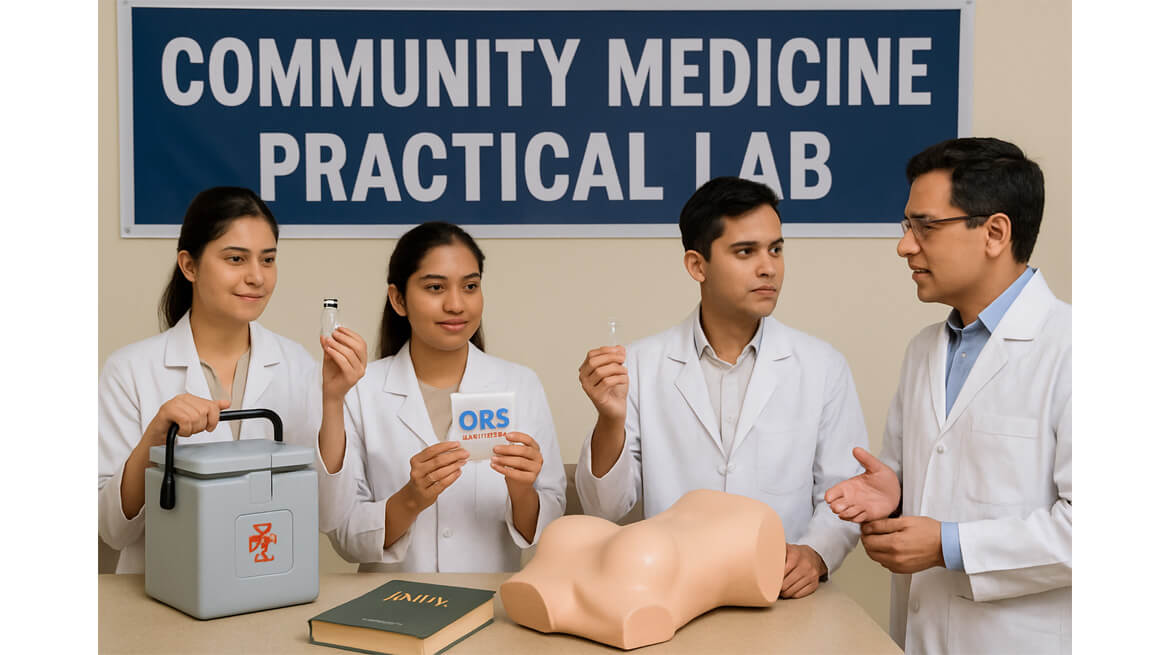
It allows students to manage vaccine vials, ORS packets, contraceptives, and locally used health tools. The student should notice the color and contour of material. Similarly for contraceptives, especially IUD and depot patches demonstration should progress from seeing on mannequins to direct supervised insertion practice for each student.
2. Sight and Reading
Students are encouraged to read labels, composition, expiry dates, vaccine vial monitors, and growth charts in real time during practical. A query lows them a deeper understanding and allows their mind to generate a query for effective learning. Posters and pictorial guides can supplement learning for large batches, allowing students to divide into sub-groups for better focus.
3. Smell and Environment
During community visits, show environmental clues such as foul smell from garbage, poor ventilation, or improper sanitation. The varied materials like insecticides, medicines, fruits and chemicals had different smells, this allows them for olfactory learning and easy identification during examination. This relates these sensory inputs to epidemiology and links theory with lived experience.
4. Taste in Nutrition Education
Tactile and gustatory learning is important for edible item learning. Many students did not even know about distinct types of flour, if they knew their teste, they also remembered their nutritional benefits. The practical can be conducted with tasting iodized salt, fortified atta, and culturally common food items while explaining nutrition deficiencies. This both enhances recall and grounds the discussion in local socio-cultural realities.
5. Hearing and Listening
This approach will also involve structured listening activities using summaries by health workers and patient stories, as well as concise recaps by the faculty. Recurring reinforcement of pointwise lists, slogans and case findings will help the auditory learner and reinforce the memory.
Strengthening the Practical’s Teaching Process –

Conclusion
Community Medicine is not another subject of MBBS- it is the health practice of all. The multisensory method falls into line with constructivist learning theories which involve active learning and development of knowledge based on at once experienced experiences as opposed to a structured process of reception. The shift in pedagogical thinking, where learning is no longer primarily a cognitive activity, but rather one that is embodied and based on experience, is bolstered by evidence suggesting that better retention and more in-depth understanding can be achieved by stimulating more than one sensory pathway in the process of learning (5). The effective adoption of a model of this type would result in increasing the effectiveness of community healthcare interventions and resulting in improved community health overall by creating a more capable and caring medical workforce.
References –
- Hilleren IHS, Christiansen B, Bjørk IT. Learning practical nursing skills in simulation centers – A narrative review. Int J Nurs Stud Adv. 2022; 4:100090. Available from: https://doi.org/10.1016/j.ijnsa.2022.100090
- Xu Y, Jiang Z, Ting DSW, Kow AWC, Bello F, Car J, et al. medical education and physician training in the era of artificial intelligence. Singapore Med J. 2024; 65(3):159-166. Available from: https://doi.org/10.4103/singaporemedj.smj-2023-203
- Roberts D, Roberts NJ. Maximizing sensory learning through immersive education. J Nurs Educ Pract. 2014;4(10):74-79. Available from: https://doi.org/10.5430/jnep.v4n10p74
- Mylonas CC, Lazari EC, Menti A, Manou E, Kavantzas N, Lazaris AC, et al. Preclinical medical education: pathology through the eyes of experiential and integrated learning. Discov Educ. 2024;3(1):273. Available from: https://doi.org/10.1007/s44217-024-00379-1
- Volpe G, Gori M. Multisensory Interactive Technologies for Primary Education: From Science to Technology. Front Psychol. 2019; 10:1073. Available from: https://doi.org/10.3389/fpsyg.2019.01076