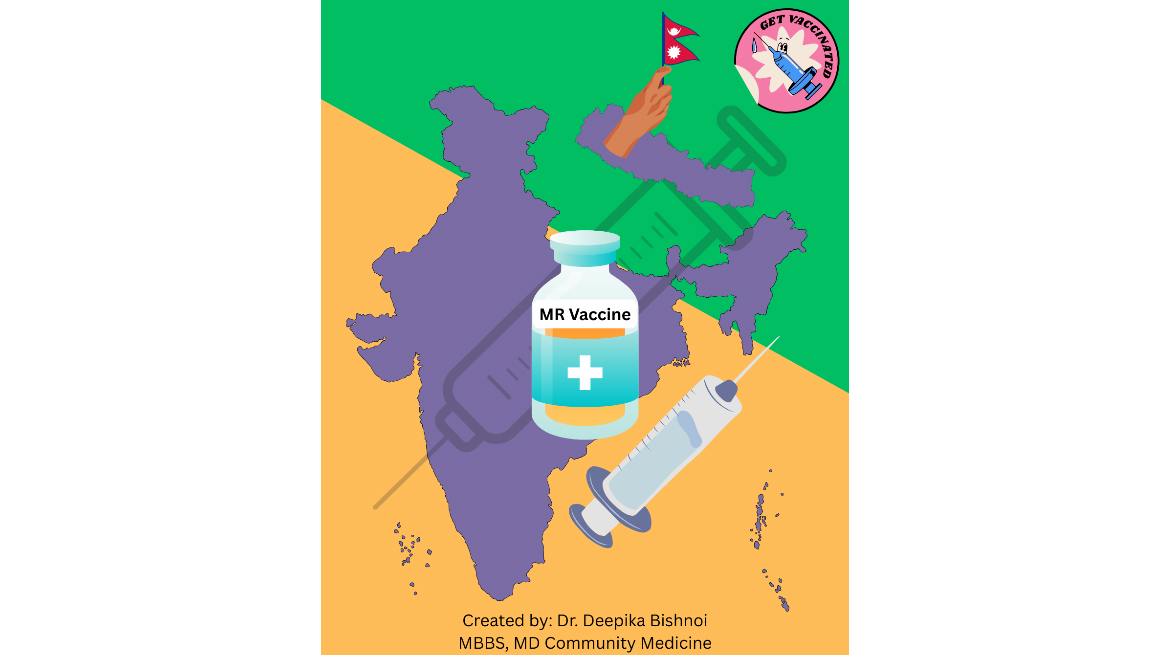
On August 19, 2025, the World Health Organization (WHO) officially declared Nepal free from rubella. [1] For India, this is more than just good news from a neighbor—it’s a wake-up call. If a smaller country like Nepal, with its own challenges, can achieve this milestone, surely India, with its vast health system and resources, can too.
What is Rubella and Why Does it Matter?
Rubella, often called “German measles,” may look like a harmless childhood rash, but its dangers are hidden. If a pregnant woman gets infected, especially in the first three months, the baby can be born with Congenital Rubella Syndrome (CRS). CRS can cause lifelong problems like heart defects, deafness, blindness, and even miscarriages. Globally, about 100,000 babies are affected by CRS every year. [2]
So, rubella elimination isn’t just about avoiding a fever or a rash—it’s about protecting unborn babies and families from heartbreak.
India’s Journey So Far
India has been working toward eliminating measles and rubella together since 2019, first aiming for 2023, but the deadline was extended to 2026. [3] Despite the delay, progress has been strong:
- Vaccine coverage has improved – More children are getting the measles-rubella shots than ever before. In 2005, only about 1 in 4 children received the second measles dose; by 2021, that number jumped to more than 8 in 10. The rubella vaccine has seen even bigger growth—from just 6% coverage to nearly 90%. [4]
- Fewer children are falling sick – In those years, measles cases dropped by more than half, and rubella cases nearly by half too. [4]
- District-level progress is visible – In the first quarter of 2025 alone, 332 districts reported zero measles cases, and 487 districts reported zero rubella cases. [5]
Major campaigns like Mission Indradhanush and the new National Zero Measles–Rubella Elimination Campaign (2025–26) are now pushing to vaccinate every last child. [6]
India’s Strengths, Challenges, and What Lies Ahead
India has strong immunization programs in place. The Universal Immunisation Programme (UIP) and Mission Indradhanush have been game changers, making vaccines accessible to millions. A growing lab network and nationwide vaccination drives are also strengths.
The challenges are that, vaccine coverage is uneven—some states are doing really well, but others are still behind. Surveillance systems sometimes miss cases or report too late, which slows down response. The COVID-19 pandemic also disrupted vaccination campaigns, leaving some children unprotected.
Nepal’s achievement gives India a strong push, showing the goal is possible. High-level campaigns keep the political momentum alive, and new digital tools (eVIN, UWIN) for vaccine trackers, logistics and dashboards—can help find gaps faster.
If vaccination coverage slips, rubella can spread among older children and adults, raising the risk of CRS. Vaccine hesitancy and misinformation still discourage some parents. And, since viruses don’t respect borders, India must also watch out for rubella being brought in from other regions.
From Policy to Action: What India Must Do
For India to achieve rubella elimination, policies must translate into concrete action at every level of the health system. First, achieving and sustaining at least 95% coverage with two doses of the measles-rubella vaccine requires meticulous micro-planning at the district and block levels, ensuring that no child is left behind, especially in underserved and hard-to-reach populations. Strengthening surveillance is equally critical. India must shift fully to case-based detection of all fever and rash illnesses, expand laboratory capacity, and ensure rapid reporting and response, thereby enabling early detection of outbreaks.
Preparedness for outbreaks is another priority. Supplementary Immunization Activities (SIAs) must be timely, locally adapted, and supported by rapid-response teams to contain transmission when clusters of cases emerge. Building community trust is central to these efforts. Targeted outreach, culturally sensitive communication, and the use of local influencers or community leaders can help overcome vaccine hesitancy and misinformation. Financial and political commitment must also be sustained: national campaigns like the Zero Measles–Rubella Elimination Campaign will only succeed if adequately funded and consistently prioritized at all administrative levels. Finally, leveraging digital innovations such as electronic vaccine registries, real-time dashboards, and geo-tagged monitoring can improve vaccine logistics, track defaulters, and enhance accountability. Together, these measures create a pathway to move from aspirational policy documents to tangible on-the-ground success.
Conclusion
Nepal’s success is not just a celebration—it’s an ask. With millions of children, India’s task is bigger, but the rewards are greater too. By closing the last immunization gaps, strengthening surveillance, and ensuring communities believe in vaccination, India can eliminate rubella. The target: 2026– it’s within reach.
The question is no longer if India can do it—it’s whether we will act fast enough to make it happen.
References
- World Health Organization. Regional Office for South-East Asia. Framework for verification of measles and rubella elimination in the WHO South-East Asia Region. New Delhi: WHO-SEARO; 2020. Available from: https://apps.who.int/iris/handle/10665/332737
- World Health Organization. Rubella. Geneva: WHO; 2023. Available from: https://www.who.int/news-room/fact-sheets/detail/rubella
- Khanal S, Bura V, Sangal L, Sethi R, Dhongde D, Bahl SK. Progress towards measles and rubella elimination in the South-East Asia Region—2013–2023. Vaccines. 2024;12(10):1094. doi: 10.3390/vaccines12101094
- Murugan R, VanderEnde K, Dhawan V, Haldar P, Chatterjee S, Sharma D, et al. Progress toward measles and rubella elimination—India, 2005–2021. MMWR Morb Mortal Wkly Rep. 2022;71(50):1569-75. doi: 10.15585/mmwr.mm7150a1
- Ministry of Health and Family Welfare, Government of India. National Zero Measles–Rubella Elimination Campaign 2025–26. New Delhi: Press Information Bureau; 2025. Available from: https://www.pib.gov.in/PressReleasePage.aspx?PRID=2124032
- World Health Organization. India vaccinates 30 million children against measles and rubella in 7 months. Geneva: WHO; 2023. xAvailable from: https://www.who.int/india/news-room/feature-stories/detail/india-vaccinates-30-million-children-against-measles-and-rubella-in-7-months