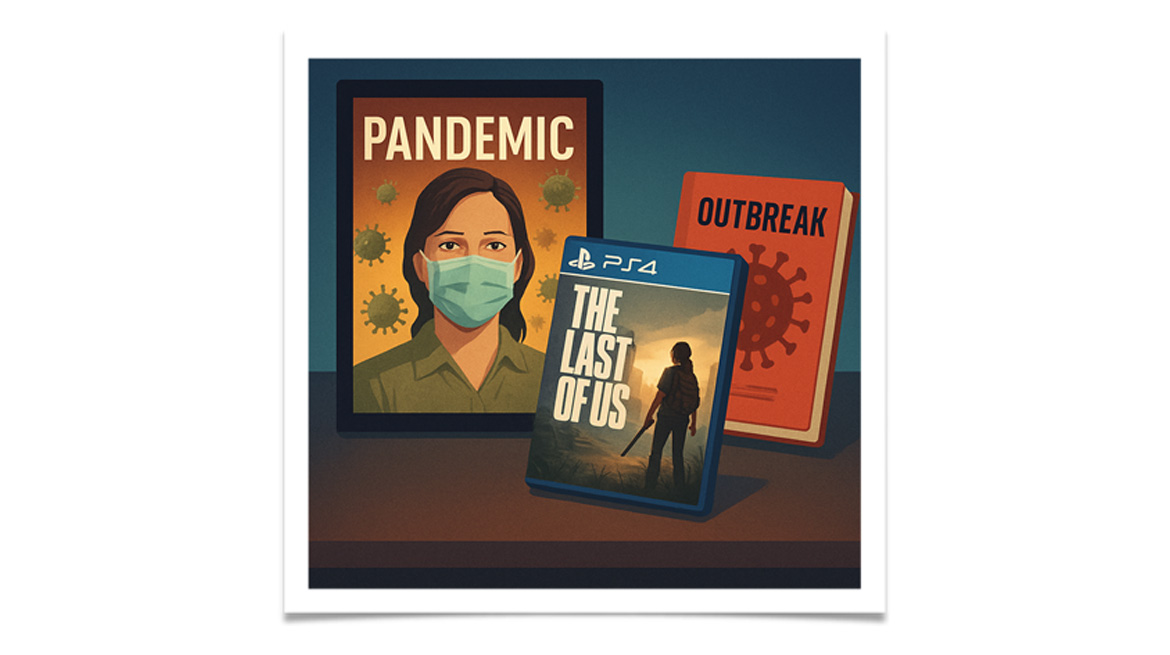
The popcorn crackles, the lights go down, and a brand-new health threat appears on the screen. Or maybe you’re playing a video game where you have to fight to stop a worldwide outbreak, or you’re immersed in a book where a mysterious disease spreads across continents. Pop culture has always been fascinated by pandemics, as seen in films like Contagion, Plague Inc., The Hot Zone, and The Last of Us. However, as public health practitioners, it is important to consider how these made-up outbreaks, these “pop culture pandemics,” actually influence our perceptions, anxieties, and behaviours in relation to actual health emergencies.
It’s simple to write off entertainment as simple escape. But the stories we hear have a lot of power. They mirror our fears, support our opinions, and occasionally unintentionally turn into our main information source. This blurring of fiction and reality became glaringly obvious in the COVID-19 era. In an attempt to make sense of an unprecedented worldwide event, many turned to movie plots or even played pandemic simulations.
The various ways that pop culture pandemics affect our perceptions of health will be examined in this blog, along with their effects, potential drawbacks, and ways that public health can use these potent narrative devices for positive ends.
The Positive, Negative, and Biohazard: What Pop Culture Does Right (and Wrong)
A simplified, dramatised perspective on intricate epidemiological events is provided by fictional pandemics. They can strike very close to home at times.
The Enlightening Discoveries:
- Emphasising the World’s Interconnectedness: Movies like Contagion eloquently show how a single cough in Hong Kong can trigger a worldwide emergency. They highlight how diseases spread quickly as a result of contemporary travel and trade, which is a basic public health idea that is frequently difficult for the general public to understand.
- Highlighting the Function of Public Health Experts: Some stories do shed light on epidemiologists, researchers, and public health officials, despite frequently being overshadowed by heroes in the military or in medicine. Characters like Kate Winslet’s character Dr. Meryl Emmerich in the film Contagion provide a unique look into the unsung heroes of disease control by showcasing the laborious process of contact tracing, data analysis, and vaccine development.
- Illustrating Behavioural Changes: A lot of stories show how a pandemic affects society, including mask wearing, social distancing, lockdowns, and the frantic pursuit of treatments. Even if they are fictional, these stories can gently prepare viewers for the necessity of both individual and group responsibility in times of crisis.
- The Power of Science and Collaboration: Pop culture pandemics highlight the vital role that scientific research, international cooperation, and quick information sharing play in fending off a global threat. They frequently result in the victory of scientific creativity over illness.
The Damning Tropes and Misconceptions:
On the other hand, drama, not necessarily scientific accuracy, is what propels fictional narratives.
- Overestimated Mortality and Virulence Rates: Fictional pathogens frequently spread at unthinkable speeds and kill with near-certainty for dramatic effect. This can create a sense of hopelessness and excessive fear that is not consistent with the reality of the majority of newly emerging infectious diseases.
- The “Patient Zero” Obsession and Blame Games: Pop culture frequently sensationalises “Patient Zero,” making them a subject of fascination or even blame, despite the epidemiological validity of the idea of a point of origin. This can contribute to stigmatisation and xenophobia, taking focus away from successful public health initiatives and encouraging a “them vs. us” mentality.
- The Lone Hero/Silver Bullet Fallacy: A lot of stories revolve around a single brilliant scientist or a small band of heroes who, just in time, find a cure or vaccine. The intricate, cooperative, and frequently incremental character of scientific research and vaccine development is oversimplified by this.
- Government Malfeasance and Conspiracy Theories: A common cliche entails a corrupt government, a dubious company, or a covert plan behind the outbreak. These narratives can create a deep-seated mistrust of public health authorities, scientists, and official communications, which can make it more difficult to put necessary measures in place during a real crisis.
- Misrepresenting Disease Transmission: To fit storylines, fictional viruses frequently spread through unlikely channels or undergo incredibly fast mutations. This may lead to public confusion regarding the effectiveness of preventative measures as well as the actual routes of transmission (such as airborne versus droplet versus contact).
Public health can strategically engage with pop culture pandemics by promoting media literacy, collaborating with creators, and developing its own compelling stories. By offering scientific guidance to filmmakers and game developers, creating culturally sensitive narratives, and leveraging fandoms, accurate messages can be subtly integrated. Beyond fear, public health storytelling should emphasise resilience, solutions, and community solidarity. Pop culture shapes perceptions of illness and risk, making it vital to engage thoughtfully. Transforming fictional fears into practical lessons of shared responsibility and scientific progress ensures that entertainment becomes an ally in building trust, awareness, and collective resilience.