COMMUNITY MEDICINE AND ITS RESEARCH FRAMEWORK AS A TOOL TO COUNTER THE INFODEMIC IN CONTEMPORARY PUBLIC HEALTH
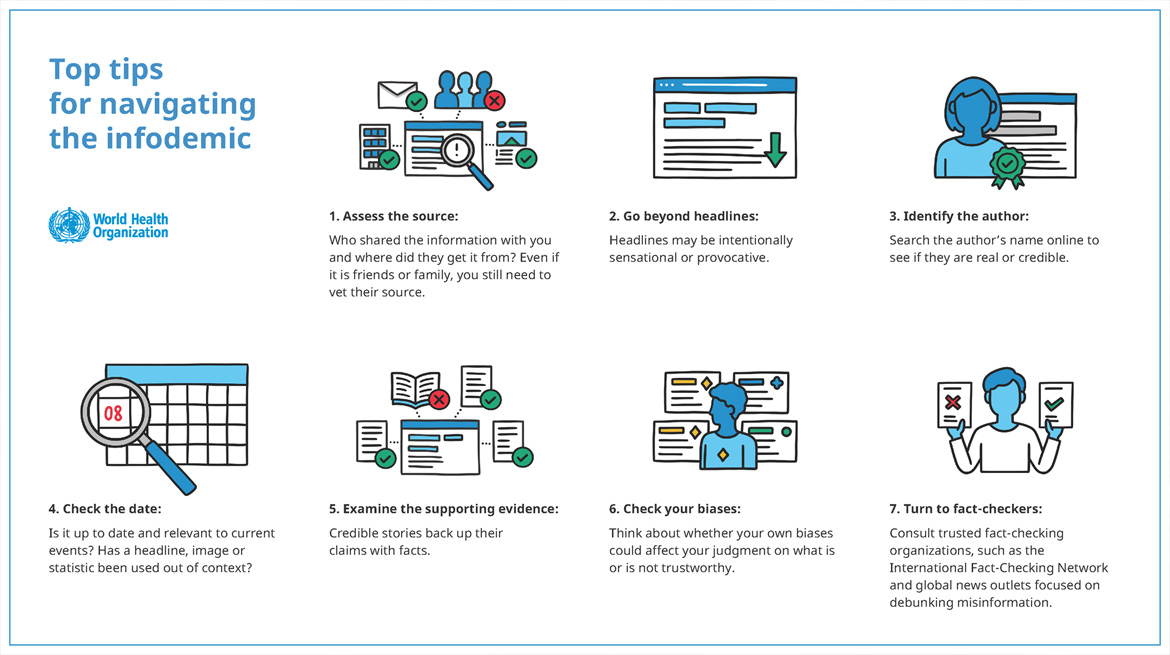
The contemporary public health landscape is facing a parallel pandemic of misinformation termed as infodemic by the World Health Organization. Infodemic is characterized by excessive circulation of both authentic and misleading health information, leading to confusion, risk-taking behaviour and erosion of trust in health systems. This article explores how the discipline of Community Medicine, through its robust epidemiological and biostatistical research methodologies, provides a scientific system for verification, validation and evidence-based management of health information during infodemic.
The term infodemic was popularized during COVID19 to describe rapid and far-reaching spread of health information and falsehoods through digital and physical networks. The WHO has recognized infodemic management as an essential pillar of epidemic preparedness. Experiences from COVID-19 vaccination hesitancy, Nipah virus outbreaks in Kerala, and recurrent dengue epidemics in India demonstrate how misinformation can alter health-seeking behavior faster than the pathogen itself.
While curative specialties focus on individual patient management, Community Medicine is uniquely positioned to address population-level information determinants of health. Its foundation in epidemiology, biostatistics, behavioral sciences and health systems research makes it a natural antidote to infodemic.
*2. Rationale: Why Community Medicine Matters in Infodemic Era*
Infodemic disrupts all three levels of prevention:
– *Primary prevention* is affected when false information reduces vaccine uptake and promotes unproven preventive remedies.
– *Secondary prevention* fails when myths about screening procedures delay early diagnosis.
– *Tertiary prevention* is compromised when patients rely on social media therapies instead of evidence-based care.
Community Medicine intervenes at all these levels through community diagnosis, health education, risk communication, and systematic research validation, which no other clinical discipline offers in a structured manner.
*3. Research Methodology of Community Medicine: A Validation Pathway for Health Information*
The core contribution of Community Medicine lies in its scientific approach to cross-verification and validation. It can be understood as a five-tier pathway:
*3.1. Community-Based Assessment and Problem Identification*
The initial step involves descriptive studies such as Knowledge, Attitude and Practice [KAP] surveys, focus group discussions and community diagnosis exercises. For instance, quantifying what proportion of a population believes that Nipah virus spreads through poultry consumption provides measurable evidence of the extent of misinformation.
*3.2. Epidemiological Framework for Source Analysis*
The classical epidemiological triad is adapted to understand infodemic dynamics. The misinformation itself acts as the agent, susceptible individuals with limited digital health literacy act as hosts, and social media platforms, community networks and ecological stressors constitute the environment. This framework helps trace origin and transmission channels of rumors.
*3.3. Analytical Verification Through Epidemiological Designs*
Different study designs serve different validation purposes:
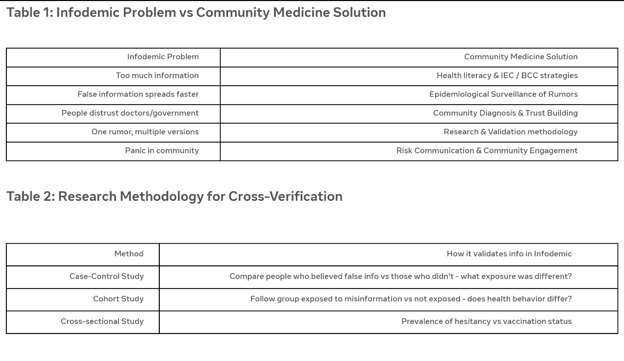
– *Cross-sectional studies* estimate the prevalence of misinformation and its association with practices such as vaccine refusal.
– *Case-control studies* compare individuals who adopted harmful practices due to misinformation with those who did not, identifying differential information exposures.
– *Cohort studies* prospectively assess whether exposure to false information leads to adverse health outcomes.
– *Ecological correlation* helps link surge in online misinformation with rise in disease incidence or hesitancy.
*3.4. Statistical Validation Through Biostatistics*
Validation in Community Medicine is quantitative and objective:
– Measures of association such as odds ratio, relative risk and attributable risk quantify the strength of link between misinformation exposure and health behaviour.
– Tests of significance including chi-square test, t-test and ANOVA determine whether observed differences are statistically valid and not by chance.
– Systematic reviews and meta-analyses performed as per PRISMA guidelines and quality appraisal through GRADE approach represent the highest level of evidence for confirming or refuting a health claim.
*3.5. Intervention and Implementation Research*
After verification, Community Medicine tests solutions through:
– *Community trials and field trials*, including randomized controlled trials of different Information, Education and Communication [IEC] strategies.
– *Operational research* under National Health Mission to evaluate whether ASHA-led counselling or Health and Wellness Centre-based messaging reduces belief in falsehoods.
– *Implementation research* to assess scalability and sustainability of validated communication models within the existing health system.
*4. Operational Model for Infodemic Management Aligned with WHO Framework*
The WHO infodemic management model includes four domains: listening, understanding, engaging and empowering communities to act. Community Medicine operationalizes these domains as:
– *Listening:* Integration of social listening with Integrated Disease Surveillance Programme and community-based surveillance through frontline workers.
– *Understanding:* Qualitative research methods to explore socio-cultural reasons behind belief in misinformation.
– *Engaging:* Community participation through Panchayati Raj Institutions, Village Health Sanitation and Nutrition Committees, self-help groups and religious leaders to co-create context-specific messages.
– *Acting and Evaluating:* Development of evidence-based risk communication and measuring its impact through pre-test and post-test studies.
*5. Illustrative Application: Nipah Virus Outbreak and Information Management*
During Nipah outbreaks in Kerala, departments of Community Medicine contributed through rapid epidemiological investigations that clarified incubation period, case fatality ratio and transmission route, which is direct human-to-human through body fluids and bat-to-human through contaminated fruits, with Pteropus bats as natural reservoir. Simultaneously, KAP studies debunked prevailing myths regarding airborne spread or transmission through poultry and water. This real-time application demonstrates how epidemiological methods serve both disease control and information validation.
*6. Conclusion*
Infodemic cannot be controlled by clinical expertise alone or by censorship. It requires scientific scrutiny, population-based evidence and community engagement. Community Medicine, with its comprehensive toolkit of descriptive, analytical, experimental and biostatistical methods, offers a systematic, reproducible and culturally acceptable mechanism to transform information overload into actionable public health intelligence. Strengthening research capacity in Community Medicine is therefore essential for building resilience against future infodemics in India and globally.
*References*
1. World Health Organization. An ad hoc WHO technical consultation managing the COVID-19 infodemic: call for action. Geneva: WHO; 2020.
2. Eysenbach G. How to fight an infodemic: the four pillars of infodemic management. J Med Internet Res. 2020;22:.
3. Park K. Park’s Textbook of Preventive and Social Medicine. 27th ed. Jabalpur: Banarsidas Bhanot; 2023.
4. Bonita R, Beaglehole R, Kjellström T. Basic Epidemiology. 2nd ed. Geneva: WHO; 2006.[6]